
Aluminium extrusion drawings often name an alloy the way they name a paint colour — a habit carried from the last project, rarely revisited. That’s a missed decision. The 6000-series alloys used for the overwhelming majority of extruded profiles are close cousins chemically, but 6061, 6063 and 6082 extrude, finish and perform differently enough that the “wrong” choice for the application shows up as a longer lead time, a rejected surface finish, or a part that’s stronger — and more expensive — than it needed to be.
What actually differs between the three
6063 is the alloy extrusion was built around: lower alloying content gives it the best extrudability of the group, which means faster press speeds, better surface finish straight off the die, and the ability to hold finer, more complex profile geometry — thin walls, tight internal voids, decorative sections. Its trade-off is lower mechanical strength. It’s the standard choice for architectural sections, enclosures, trim and heat sinks where section complexity and cosmetic finish matter more than ultimate strength.
6061 sits in the middle: a well-balanced general-engineering alloy with meaningfully higher strength than 6063 (particularly in the T6 temper) at some cost in extrudability — profiles are typically simpler, wall sections thicker, and press speeds slower. It’s a genuine workhorse for structural brackets, frames and fixtures, and it’s also the alloy most readily available as plate and bar stock, which matters if the same part might later be partly machined rather than extruded.
6082 pushes further toward strength: a higher-strength structural alloy (common in European structural design, where it’s a standard specification for load-bearing sections) that extrudes less readily than 6061, with correspondingly higher press force and more conservative section geometry. It earns its place in structural framing, load-bearing brackets, and any application where 6061’s strength margin isn’t quite enough and going to a different material class entirely would be overkill.
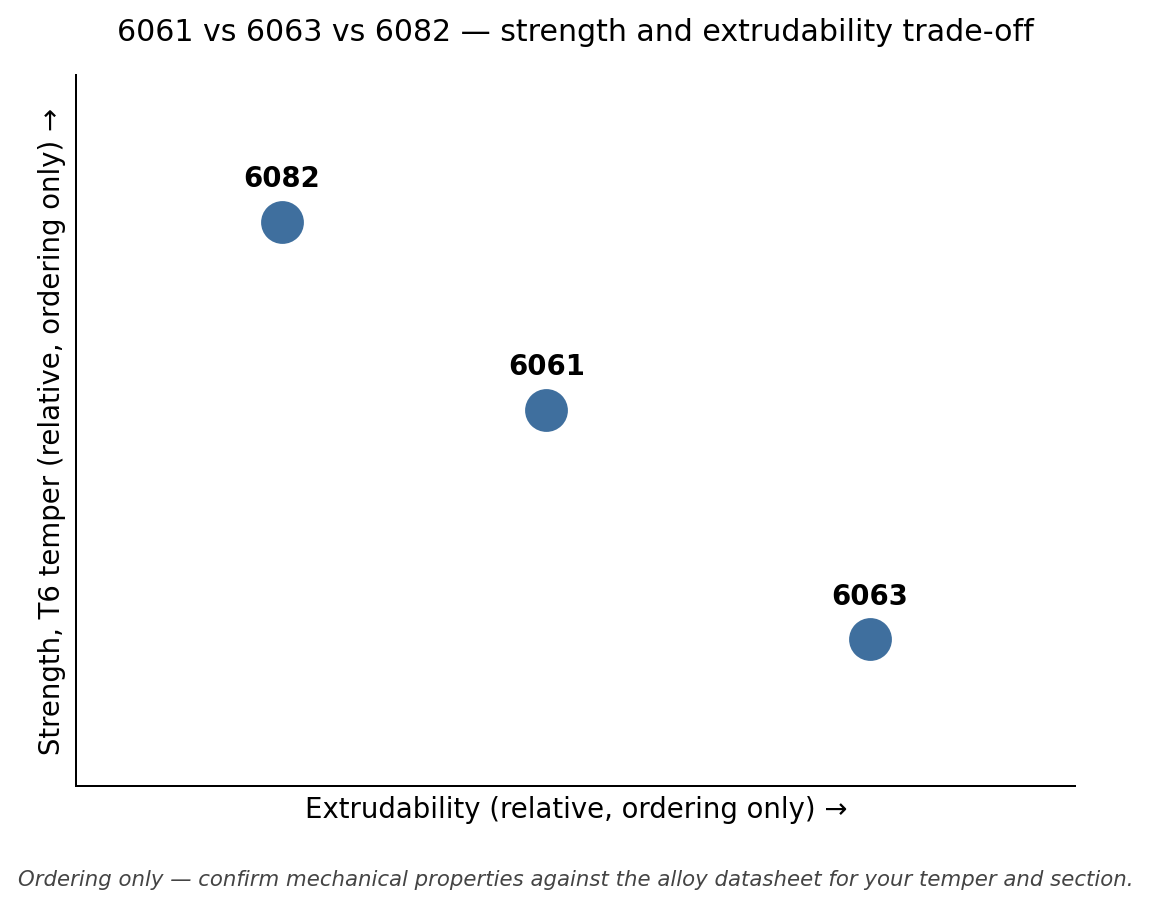
Comparison table
| Property | 6063 | 6061 | 6082 |
|---|---|---|---|
| Relative strength (T6 temper) | Lower | Moderate–high | Highest of the three |
| Extrudability | Best — fine detail, thin walls, fast press speed | Moderate — thicker sections, slower press speed | Lowest of the three — needs higher press force, simpler sections |
| Surface finish / anodising response | Excellent — the default for cosmetic anodised work | Good, slightly less uniform than 6063 | Functional; less commonly chosen for decorative anodising |
| Typical applications | Architectural sections, enclosures, trim, heat sinks | General structural brackets, frames, fixtures | Load-bearing structural sections, higher-stress brackets |
| Relative tooling/press cost impact | Lowest — easiest on the die | Moderate | Highest — most demanding on tooling and press capacity |
Treat this as an ordering to guide the conversation, not a substitute for the actual alloy datasheet and your structural calculation — always confirm mechanical properties against the specific temper and section thickness you need.
How the choice changes the quote, not just the part
Extrudability differences aren’t academic — they show up directly in die design and press scheduling. A complex thin-wall profile that extrudes cleanly in 6063 may simply not be extrudable in 6082 at commercially sensible press speeds; the die would need a simpler, more conservative profile, which can mean redesigning the cross-section rather than just re-quoting the same drawing in a different alloy. Higher-strength alloys generally also need higher press tonnage, which can push a job onto a larger, less available press and add lead time independent of order size. None of this is a reason to avoid 6061 or 6082 where the strength is genuinely needed — it’s a reason to settle the alloy before the profile geometry is finalised, so the die is designed for the alloy that will actually run through it.
Anodising response is the other quiet cost driver. 6063 takes clear and coloured anodising more uniformly than 6061, and both outperform 6082 and cast material for cosmetic work — a die-cast or 6082 bracket that needs a premium clear-anodised finish may cost more to get there evenly than the same finish on 6063, purely because of how the alloy’s own microstructure interacts with the anodising bath. If surface finish is part of the specification, say so at the alloy-selection stage.
A simple decision rule
Start from the load, not the habit. If the part is a heat sink, an enclosure, trim, or anything where wall thickness, cosmetic finish or fine geometry drive the design, default to 6063 and confirm strength is adequate for the actual loads involved — it usually is, since most of these parts aren’t structurally loaded in any serious sense. If the part carries real structural load — a bracket under sustained force, a frame member, anything with a genuine stress calculation behind it — start from 6061 as the general-purpose structural default, and move to 6082 only if the calculation shows 6061 doesn’t clear the margin with a section size that still fits the assembly. Moving straight to the highest-strength alloy “to be safe” usually just means paying for extrudability and finish quality the part doesn’t need.
What to put on the RFQ
State the alloy and temper explicitly rather than leaving it to be assumed from the drawing’s dimensions. If strength is the driver, state the actual load case so the alloy and section can be checked together rather than in isolation. If cosmetic finish matters, say so before the alloy is locked in, since it changes the recommendation as much as strength does. And if the part might be die-cast rather than extruded — a live question for many brackets and housings — that’s a separate process decision worth having early, because die-cast aluminium alloys are a different family again with their own strength and finish characteristics.
Where PA fits
Through its network of specialist aluminium fabrication partners, PA International works across aluminium extrusion in 6063, 6061 and 6082 (and related 6000-series alloys), alongside aluminium fabrication and finishing — anodising, powder coating, machining after extrusion — so the alloy, the profile and the finish get engineered together rather than negotiated separately after tooling is cut. It’s also worth reading alongside our earlier note on heat pipes and heat sink design, since heat-sink base and fin material selection runs into exactly this alloy trade-off.
If you have a profile drawing without a confirmed alloy — or an alloy that was chosen for a different application and inherited by this one — send us the load case, the finish requirement and the section geometry, and we’ll tell you whether 6061, 6063 or 6082 is the right starting point. Get in touch to scope an extrusion project.